Media & Newsletter

The scientific challenge

The FABEST HCF Competition is open to research groups, universities, laboratories, industrial partners and individual researchers working on fatigue modelling, multiaxial fatigue criteria, fatigue-life prediction and benchmark validation.

Participants are asked to submit blind fatigue-life predictions for 42CrMo4+QT steel specimens tested under high-cycle fatigue conditions. The blind target cases include plain and notched cylindrical specimens subjected to combined axial and torsional loading, including in-phase and 90° out-of-phase loading histories, with constant internal pressure.

The objective is to compare different fatigue-life prediction methods on the same well-characterised experimental basis and to assess their robustness under proportional and non-proportional multiaxial loading conditions.

Experimental database

Participants will receive a common experimental package including:

  • specimen geometries and technical drawings;
  • material information for 42CrMo4+QT steel;
  • static tensile properties and fatigue calibration datasets (60 S-N curves and 1 Manson-Coffin curve);
  • surface roughness measurements;
  • hardness measurements;
  • residual-stress information, when available;
  • test setup and test-sequence documentation;
  • public blind load matrix;
  • Excel submission template;
  • Word and LaTeX method-description templates.

All competition information and datasets will be made available on Zenodo as downloadable zipped folders.

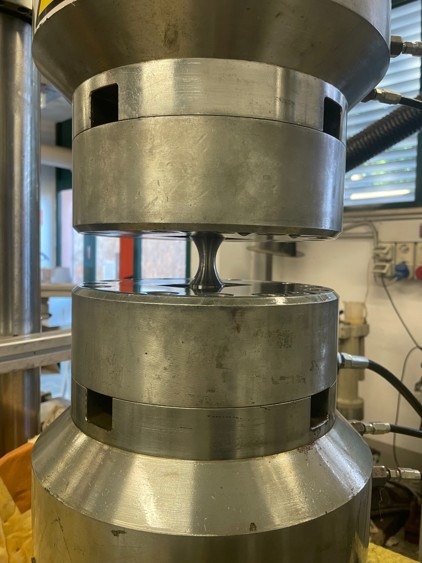
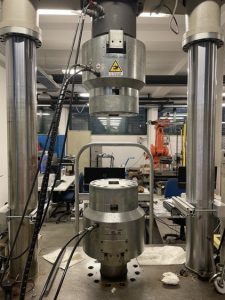
Hollow cylindrical specimen installed in the Schenck grips during setup of the internal-pressure fatigue tests.

Key information

Field Information
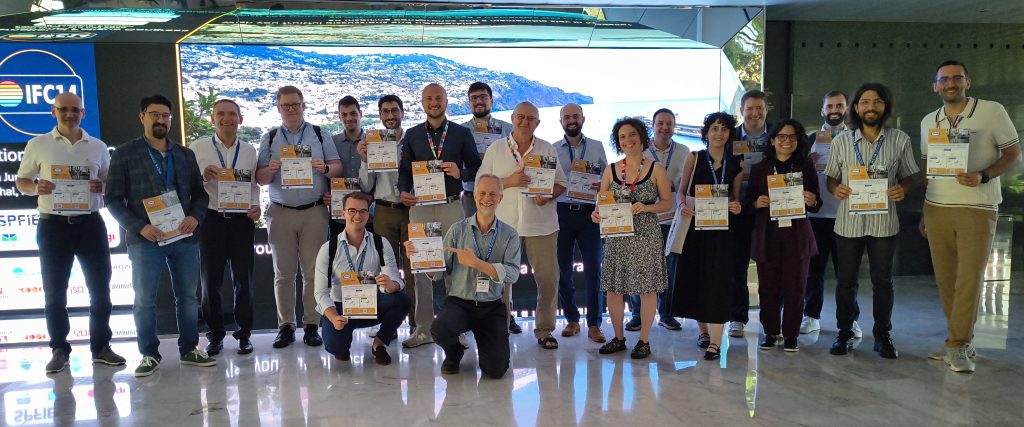
Official launch 28 June 2026, during IFC14, Madeira
Submission deadline 31 October 2026
Format Blind fatigue-life prediction benchmark
Material 42CrMo4+QT steel
Loading Multiaxial loading (i.e. axial-torsional) with constant internal pressure
Specimens Plain and notched cylindrical specimens
Submission files Excel prediction template plus method-description document
Data access Zenodo zipped package
Registration here
Zenodo package here

Prizes and recognition

Research groups may participate in the competition; however, only one person per group can receive the prize.

Prizes will be awarded to the two best predictions:

  • 1st place: funding for one-month Short-Term Scientific Mission (STSM) within FABER COST Action framework;
  • 2nd place: free participation in the 2nd Annual FABER Conference 2027

Both first- and second-place contributors will also be invited to join as co-authors of the round-robin paper presenting the competition results, which will be published in a high-impact journal.

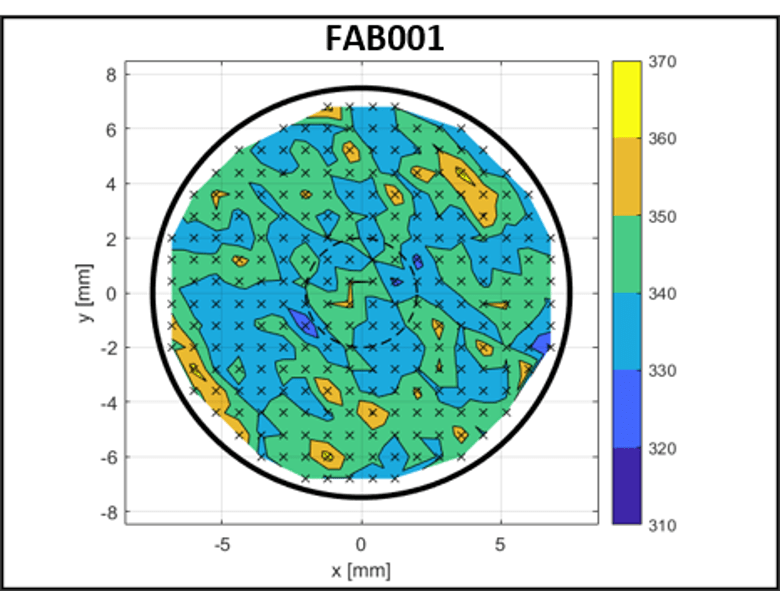
Example of material-characterisation data included in the FABEST database: HV10 hardness map of a 42CrMo4+QT specimen section.

How to participate

  1. Register for the competition, so that you can be updated whenever some new information is delivered.
  2. Download the FABEST HCF Zenodo package.
  3. Access the paper submitted to Data in Brief journal to document the data package of item 2.
  4. Read the Start Here file and the Competition Rules including evaluation metrics.
  5. Study the experimental basis, specimen geometries, load matrix and test-protocol documents.
  6. Calibrate the fatigue model using the provided experimental data.
  7. Complete the Excel prediction template.
  8. Complete either the Word or LaTeX method-description template.
  9. Submit the required files before the deadline of October 31.

Flyer:

Design by Silvia Balloni
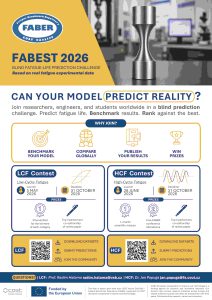
FABEST IFC14 flyer

Clicking on the picture above will redirect to the high-resolution .pdf format of the flyer.

The design is made by Silvia Balloni. More of the author’s work can be found here.

Contacts

For questions about the HCF competition:

Registration is now open for the upcoming FABER Training School on benchmarking and fatigue data analyses, taking place from July 14–17 in Figueira da Foz.

Program Overview

  • July 14–15: Statistical and probabilistic analysis of fatigue data, led by keynote lecturers Alfonso Fernández-Canteli and Diego Díaz Salamanca.

  • July 16 (Afternoon): A scheduled site visit to Coimbra University.

  • July 16–17: Collaborative sessions to establish data treatment rules for FABER. Participants will work in small, task-oriented groups and present their findings daily.

    The programme is aimed at researchers, engineers, and PhD students interested in fatigue characterization, probabilistic modelling, and the development of reliable methodologies for fatigue design.

Call for Contributors

The agenda for the final two days remains flexible. If you are interested in delivering a lecture related to the core topics, please indicate your availability in the registration form.

Registration

Please express your interest by completing the registration form below no later than Wednesday, June 17:

👉 Training School Registration Form

Thank you for your prompt attention and participation.

The deadline for applications was extended to 28 June 2026.

We are reopening the call as there are still a few places left.

So, if interested, apply using this form: https://forms.cloud.microsoft/e/9475qazptp.

Preparing for the FABEST LCF Competition: Data, Models, and Life Prediction

Dates: July 28–30, 2026
Venue: New Assembly Hall (UA3), VŠB – Technical University of Ostrava, Czech Republic
Organized by: FABER COST Action (CA23109) – WG 4.7 Low-Cycle Fatigue, prof. Radim Halama

Overview

The FABER Training School is a 3-day intensive program designed mainly for PhD students, early-career researchers, and industry professionals (participation is not limited by age). The school provides a deep dive into the experimental and numerical aspects of Low-Cycle Fatigue (LCF), with a special focus on the challenges of cyclic softening, ratcheting, and mean stress relaxation.

This training is specifically designed to support participants of the FABEST LCF Competition, providing them with the necessary tools and knowledge to master the competition dataset and improve their predictive models.


List of Lecturers & Experts

We are honored to host a team of international experts in the fields of cyclic plasticity, computation fatigue analysis, and experimental mechanics:

  • Prof. Spyros A. Karamanos (University of Thessaly, Greece)
  • Assoc. Prof. Łukasz Pejkowski (Bydgoszcz University of Science and Technology, Poland)
  • Dr. Isaac Hong (The Ohio State University, US)
  • Dr. Niloy Khutia (Indian Institute of Engineering Science and Technology, India)
  • Assoc. Prof. František Šebek (Brno University of Technology, Czechia)
  • Prof. Radim Halama (VŠB – Technical University of Ostrava, Czechia)
  • Additional industry experts and guest lecturers to be confirmed.


Preliminary Program

The school is structured into three specialized modules:

  • Module 1: Experimental Data & Evaluation
    Understand the fundamentals of LCF testing, data quality assurance, and hands-on training with the FABER Python scripts using the high-quality 42CrMo4+QT dataset.
  • Module 2: Cyclic Plasticity Modeling
    Master the calibration of constitutive laws and learn how to implement advanced cyclic plasticity equations in FEM software (including practical guides for USERMAT in Ansys).
  • Module 3: LCF Prediction & Damage
    Apply damage accumulation rules to solve real-world challenges like ratcheting and mean stress effects on fatigue life.

👉 Download the Full Preliminary Program (PDF)


FABEST LCF Competition

The Training School is closely linked to the FABEST LCF “Blind Prediction” Competition. Participants will have a unique opportunity to discuss their modeling approaches with experts and peers before the submission deadline in October 2026.

👉 Learn more about the FABEST LCF Competition


Registration & Travel Support

  • Registration Link: Register Here via Google Forms
  • Deadline for Registration: June 22, 2026
  • Travel Support: Limited grants (reimbursement of travel and daily allowance) are available for participants from COST member countries through the FABER COST Action. Please indicate your interest in the registration form. To be eligible for support, you must be a registered member of the FABER COST Action (please apply for membership in advance as the approval process takes time).


Additional information:

Venue & Location

The school will take place at the New Assembly Hall (Building UA) in the heart of the VŠB-TUO campus.

  • Address: 17. listopadu 2172/15, 708 00 Ostrava-Poruba, Czech Republic
  • Map & Navigation: Open in Google Maps


Accommodation – Recommended Hotels

Participants are responsible for booking their own accommodation. We recommend the following options:


Travel Information – How to reach Ostrava

Ostrava is well-connected to several international airports via train and bus networks.


Option 1: Via Prague Airport (PRG), Czech Republic

  • From Airport: Take the “Airport Express” (AE) bus to Prague Main Railway Station (Praha hlavní nádraží).
  • To Ostrava: Use high-speed trains (Pendolino, RegioJet, or Leo Express). The journey takes approximately 3 hours.
  • Stop: Get off at Ostrava-Svinov station (which is closest to the University campus in Poruba).


Option 2: Via Katowice (KTW) or Krakow (KRK) Airports, Poland

  • Katowice Airport (KTW): This is the closest major international airport to Ostrava.
    • Transport: Direct bus shuttle services are operated by Leo Express and FlixBus.
    • Travel time: Approx. 1.5 hours.
    • Stop in Ostrava: Choose “Ostrava-Svinov” as your destination (closest to the university).
  • Krakow Airport (KRK):
    • Transport: Direct buses are operated by FlixBus (several times a day).
    • Travel time: Approx. 2 – 2.5 hours.
    • Stop in Ostrava: Choose “Ostrava-Svinov”.


Option 3: Via Vienna Airport (VIE), Austria

  • Transport: Direct trains run from Vienna Main Station (Wien Hbf) or direct buses from the airport to Ostrava. The journey takes about 3.5 – 4 hours.


Local Transport in Ostrava

  • From the Ostrava-Svinov train station, take any tram heading towards “Poruba” (Trams No. 7, 8, 17) and get off at the “Hlavní třída” (closer to the venue and Sareza hotel) or “VŠB-TUO” (closer to Hotel Garni) stop.
  • You can pay for all public transport using a contactless credit/debit card directly inside the tram/bus (just “tap” when you enter).  No need to buy paper tickets.


Contact Information

For any questions regarding the training school, please contact:
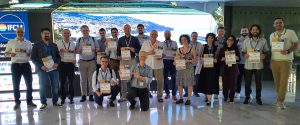
The 1st Annual FABER Conference successfully concluded its proceedings in the Adriatic coastal municipality of Jelsa on the island of Hvar.

The two-day event serves as a foundational platform for advancing research in fatigue analysis. The technical agenda featured 28 peer-reviewed presentations delivered across 12 hours of academic lectures, focusing on four pillars of the FABER initiative:

  1. Model Validation: Defining benchmarks to verify and validate predictive fatigue models.

  2. Data Integration: Aggregating a centralized database of empirical fatigue experiments.

  3. Open-Source Software: Supporting the development of the FatPy open-source fatigue library.

  4. Global Engagement: Coordinating the international FABEST competition.

The primary objective of this 2026 sevent was to cultivate strategic partnerships and establish collaborative research channels among pioneering teams. To maximize meaningful engagement, attendance at this inaugural edition was restricted to internal FABER members – a strategy that yielded highly productive academic dialogue.

Moving forward, the FABER Conference will be held annually each May. In 2027, the organizing committee will open the call for papers and registration to the broader engineering and scientific community.

The FABER Conference 2026 Proceedings can be found in the repository part of the FABER website.

The full gallery from the event made by https://elenphotography.com/ can be found here | Events section of this website.

The continuing Iranian crisis made us to relocate the FABER Conference from the originally planned Antalya.

After frantic search, we have the new place, this is hotel Hvar in Jelsa on Hvar island, Croatia.

The program for the conference can be downloaded in pdf format via this link.

Some info on travel to the conference location can be downloaded here.

***

The FABER Conference 2026 Proceedings can be found in the repository part of the FABER website.

The Pictures from the event made by https://elenphotography.com/ can be found here.

The FABER COST Action (CA23109) is thrilled to announce the launch of its flagship benchmark study: the FABEST Low-Cycle Fatigue (LCF) Competition.

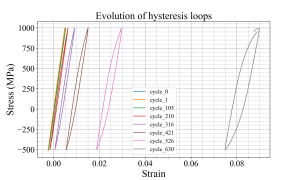
Figure 1: Evolution of hysteresis loops showing progressive strain accumulation (ratcheting) in 42CrMo4+QT steel during a stress-controlled LCF test.

This international “blind prediction” competition challenges researchers from both academia and industry to test their computational models against a new, high-quality experimental dataset.

The Scientific Challenge
The competition focuses on the complex cyclic behavior of 42CrMo4+QT steel and aims to answer key research questions:

  • Can a single set of material parameters describe both ratcheting and mean stress relaxation?
  • What is the most accurate prediction method for these complex histories?
  • How critical is it to model the material’s distinct transient cyclic softening?


Key Information:

  • Official Launch: May 5-6, 2026, at the 1st FABER Conference.
  • Submission Deadline: October 31, 2026.
  • Format: A “blind prediction” challenge. A calibration set of 24 LCF experiments is provided. The validation experiments will be performed after the submission deadline.
  • Scientific Oversight: All experiments were performed by Prof. Radim Halama at VŠB – Technical University of Ostrava to ensure data consistency. The entire process is independently verified by Prof. Spyros A. Karamanos and his team at the University of Thessaly, Greece, to guarantee full transparency.
  • Who can participate? The competition is open to everyone. Submissions are limited to a maximum of two authors.


Support: Training School in Ostrava

To help participants prepare their predictions and master the Python toolsets, a dedicated Training School will be held at VŠB – Technical University of Ostrava on July 28–30, 2026.

The program includes specialized sessions on:

  • Standardized experiment evaluation using FABER Python scripts.
  • Cyclic plasticity modeling and parameter identification, implementation in Ansys.
  • Advanced LCF life prediction and damage accumulation.

👉 Learn more and register for the Training School here.


How to Get Involved:

Ready to take on the challenge? Follow these steps to get started:

  1. Review the Rules (Quick Download)
    Before downloading the full dataset, you can review the detailed competition task, categories, and evaluation metrics here.
  2. Study the Experimental Basis
    Learn about the 42CrMo4+QT material behavior and the testing procedures used at VŠB-TUO here.
  3. Download the Full Benchmark Package
    Get the complete calibration dataset (24 experiments), submission templates, and documentation from our official repository:
    👉 [Access the Full Dataset on ZENODO]
    (Note: The package size is approximately 530 MB).
  4. Register for the FABEST LCF Competition
    Let us know you are participating! Official registration is mandatory to be eligible for prizes:
    👉 Competition Registration Form
  5. Simulate & Predict
    Tune your models using Cases 1–3 and prepare your “blind” predictions for Cases 4 and 5.
    Submission of results will open in July 2026.

FABER invites active members of the community to submit proposals for presentations at the FABER Conference 2026, taking place on May 5–6, 2026 in Antalya, Türkiye.

This year, selected speakers will have their travel and accommodation expenses covered (up to 27 reimbursed participants).

Importantly, no full paper submission is required — only a clear presentation idea outlining your work, initiative, research, or collaboration opportunity within FABER.

This is an excellent opportunity to:
• Share your work with the FABER community
• Present initiatives that could be adopted more widely
• Find collaborators for ongoing or future projects

🗓 Conference dates: May 5–6, 2026
✈ Travel window: May 4–7, 2026
📍 Location: Antalya, Türkiye
⏳ Application deadline: February 27, 2026
📩 Invitations will be sent by: March 6, 2026

Apply here: https://docs.google.com/forms/d/e/1FAIpQLSc2C2jI0JbXXGBiiGRWlBTofwdlSsrsBodNz55Vk7HOJVVLeg/viewform

If you are actively engaged in FABER and have something valuable to share, we encourage you to apply.

#FABER

The scientific challenge

The FABEST HCF Competition is open to research groups, universities, laboratories, industrial partners and individual researchers working on fatigue modelling, multiaxial fatigue criteria, fatigue-life prediction and benchmark validation.

Participants are asked to submit blind fatigue-life predictions for 42CrMo4+QT steel specimens tested under high-cycle fatigue conditions. The blind target cases include plain and notched cylindrical specimens subjected to combined axial and torsional loading, including in-phase and 90° out-of-phase loading histories, with constant internal pressure.

The objective is to compare different fatigue-life prediction methods on the same well-characterised experimental basis and to assess their robustness under proportional and non-proportional multiaxial loading conditions.

Experimental database

Participants will receive a common experimental package including:

  • specimen geometries and technical drawings;
  • material information for 42CrMo4+QT steel;
  • static tensile properties and fatigue calibration datasets (60 S-N curves and 1 Manson-Coffin curve);
  • surface roughness measurements;
  • hardness measurements;
  • residual-stress information, when available;
  • test setup and test-sequence documentation;
  • public blind load matrix;
  • Excel submission template;
  • Word and LaTeX method-description templates.

All competition information and datasets will be made available on Zenodo as downloadable zipped folders.

Hollow cylindrical specimen installed in the Schenck grips during setup of the internal-pressure fatigue tests.

Key information

Field Information
Official launch 28 June 2026, during IFC14, Madeira
Submission deadline 31 October 2026
Format Blind fatigue-life prediction benchmark
Material 42CrMo4+QT steel
Loading Multiaxial loading (i.e. axial-torsional) with constant internal pressure
Specimens Plain and notched cylindrical specimens
Submission files Excel prediction template plus method-description document
Data access Zenodo zipped package
Registration here
Zenodo package here

Prizes and recognition

Research groups may participate in the competition; however, only one person per group can receive the prize.

Prizes will be awarded to the two best predictions:

  • 1st place: funding for one-month Short-Term Scientific Mission (STSM) within FABER COST Action framework;
  • 2nd place: free participation in the 2nd Annual FABER Conference 2027

Both first- and second-place contributors will also be invited to join as co-authors of the round-robin paper presenting the competition results, which will be published in a high-impact journal.

Example of material-characterisation data included in the FABEST database: HV10 hardness map of a 42CrMo4+QT specimen section.

How to participate

  1. Register for the competition, so that you can be updated whenever some new information is delivered.
  2. Download the FABEST HCF Zenodo package.
  3. Access the paper submitted to Data in Brief journal to document the data package of item 2.
  4. Read the Start Here file and the Competition Rules including evaluation metrics.
  5. Study the experimental basis, specimen geometries, load matrix and test-protocol documents.
  6. Calibrate the fatigue model using the provided experimental data.
  7. Complete the Excel prediction template.
  8. Complete either the Word or LaTeX method-description template.
  9. Submit the required files before the deadline of October 31.

Flyer:

Design by Silvia Balloni
FABEST IFC14 flyer

Clicking on the picture above will redirect to the high-resolution .pdf format of the flyer.

The design is made by Silvia Balloni. More of the author’s work can be found here.

Contacts

For questions about the HCF competition:

Registration is now open for the upcoming FABER Training School on benchmarking and fatigue data analyses, taking place from July 14–17 in Figueira da Foz.

Program Overview

  • July 14–15: Statistical and probabilistic analysis of fatigue data, led by keynote lecturers Alfonso Fernández-Canteli and Diego Díaz Salamanca.

  • July 16 (Afternoon): A scheduled site visit to Coimbra University.

  • July 16–17: Collaborative sessions to establish data treatment rules for FABER. Participants will work in small, task-oriented groups and present their findings daily.

    The programme is aimed at researchers, engineers, and PhD students interested in fatigue characterization, probabilistic modelling, and the development of reliable methodologies for fatigue design.

Call for Contributors

The agenda for the final two days remains flexible. If you are interested in delivering a lecture related to the core topics, please indicate your availability in the registration form.

Registration

Please express your interest by completing the registration form below no later than Wednesday, June 17:

👉 Training School Registration Form

Thank you for your prompt attention and participation.

The deadline for applications was extended to 28 June 2026.

We are reopening the call as there are still a few places left.

So, if interested, apply using this form: https://forms.cloud.microsoft/e/9475qazptp.

Preparing for the FABEST LCF Competition: Data, Models, and Life Prediction

Dates: July 28–30, 2026
Venue: New Assembly Hall (UA3), VŠB – Technical University of Ostrava, Czech Republic
Organized by: FABER COST Action (CA23109) – WG 4.7 Low-Cycle Fatigue, prof. Radim Halama

Overview

The FABER Training School is a 3-day intensive program designed mainly for PhD students, early-career researchers, and industry professionals (participation is not limited by age). The school provides a deep dive into the experimental and numerical aspects of Low-Cycle Fatigue (LCF), with a special focus on the challenges of cyclic softening, ratcheting, and mean stress relaxation.

This training is specifically designed to support participants of the FABEST LCF Competition, providing them with the necessary tools and knowledge to master the competition dataset and improve their predictive models.


List of Lecturers & Experts

We are honored to host a team of international experts in the fields of cyclic plasticity, computation fatigue analysis, and experimental mechanics:

  • Prof. Spyros A. Karamanos (University of Thessaly, Greece)
  • Assoc. Prof. Łukasz Pejkowski (Bydgoszcz University of Science and Technology, Poland)
  • Dr. Isaac Hong (The Ohio State University, US)
  • Dr. Niloy Khutia (Indian Institute of Engineering Science and Technology, India)
  • Assoc. Prof. František Šebek (Brno University of Technology, Czechia)
  • Prof. Radim Halama (VŠB – Technical University of Ostrava, Czechia)
  • Additional industry experts and guest lecturers to be confirmed.


Preliminary Program

The school is structured into three specialized modules:

  • Module 1: Experimental Data & Evaluation
    Understand the fundamentals of LCF testing, data quality assurance, and hands-on training with the FABER Python scripts using the high-quality 42CrMo4+QT dataset.
  • Module 2: Cyclic Plasticity Modeling
    Master the calibration of constitutive laws and learn how to implement advanced cyclic plasticity equations in FEM software (including practical guides for USERMAT in Ansys).
  • Module 3: LCF Prediction & Damage
    Apply damage accumulation rules to solve real-world challenges like ratcheting and mean stress effects on fatigue life.

👉 Download the Full Preliminary Program (PDF)


FABEST LCF Competition

The Training School is closely linked to the FABEST LCF “Blind Prediction” Competition. Participants will have a unique opportunity to discuss their modeling approaches with experts and peers before the submission deadline in October 2026.

👉 Learn more about the FABEST LCF Competition


Registration & Travel Support

  • Registration Link: Register Here via Google Forms
  • Deadline for Registration: June 22, 2026
  • Travel Support: Limited grants (reimbursement of travel and daily allowance) are available for participants from COST member countries through the FABER COST Action. Please indicate your interest in the registration form. To be eligible for support, you must be a registered member of the FABER COST Action (please apply for membership in advance as the approval process takes time).


Additional information:

Venue & Location

The school will take place at the New Assembly Hall (Building UA) in the heart of the VŠB-TUO campus.

  • Address: 17. listopadu 2172/15, 708 00 Ostrava-Poruba, Czech Republic
  • Map & Navigation: Open in Google Maps


Accommodation – Recommended Hotels

Participants are responsible for booking their own accommodation. We recommend the following options:


Travel Information – How to reach Ostrava

Ostrava is well-connected to several international airports via train and bus networks.


Option 1: Via Prague Airport (PRG), Czech Republic

  • From Airport: Take the “Airport Express” (AE) bus to Prague Main Railway Station (Praha hlavní nádraží).
  • To Ostrava: Use high-speed trains (Pendolino, RegioJet, or Leo Express). The journey takes approximately 3 hours.
  • Stop: Get off at Ostrava-Svinov station (which is closest to the University campus in Poruba).


Option 2: Via Katowice (KTW) or Krakow (KRK) Airports, Poland

  • Katowice Airport (KTW): This is the closest major international airport to Ostrava.
    • Transport: Direct bus shuttle services are operated by Leo Express and FlixBus.
    • Travel time: Approx. 1.5 hours.
    • Stop in Ostrava: Choose “Ostrava-Svinov” as your destination (closest to the university).
  • Krakow Airport (KRK):
    • Transport: Direct buses are operated by FlixBus (several times a day).
    • Travel time: Approx. 2 – 2.5 hours.
    • Stop in Ostrava: Choose “Ostrava-Svinov”.


Option 3: Via Vienna Airport (VIE), Austria

  • Transport: Direct trains run from Vienna Main Station (Wien Hbf) or direct buses from the airport to Ostrava. The journey takes about 3.5 – 4 hours.


Local Transport in Ostrava

  • From the Ostrava-Svinov train station, take any tram heading towards “Poruba” (Trams No. 7, 8, 17) and get off at the “Hlavní třída” (closer to the venue and Sareza hotel) or “VŠB-TUO” (closer to Hotel Garni) stop.
  • You can pay for all public transport using a contactless credit/debit card directly inside the tram/bus (just “tap” when you enter).  No need to buy paper tickets.


Contact Information

For any questions regarding the training school, please contact:
The 1st Annual FABER Conference successfully concluded its proceedings in the Adriatic coastal municipality of Jelsa on the island of Hvar.

The two-day event serves as a foundational platform for advancing research in fatigue analysis. The technical agenda featured 28 peer-reviewed presentations delivered across 12 hours of academic lectures, focusing on four pillars of the FABER initiative:

  1. Model Validation: Defining benchmarks to verify and validate predictive fatigue models.

  2. Data Integration: Aggregating a centralized database of empirical fatigue experiments.

  3. Open-Source Software: Supporting the development of the FatPy open-source fatigue library.

  4. Global Engagement: Coordinating the international FABEST competition.

The primary objective of this 2026 sevent was to cultivate strategic partnerships and establish collaborative research channels among pioneering teams. To maximize meaningful engagement, attendance at this inaugural edition was restricted to internal FABER members – a strategy that yielded highly productive academic dialogue.

Moving forward, the FABER Conference will be held annually each May. In 2027, the organizing committee will open the call for papers and registration to the broader engineering and scientific community.

The FABER Conference 2026 Proceedings can be found in the repository part of the FABER website.

The full gallery from the event made by https://elenphotography.com/ can be found here | Events section of this website.

The continuing Iranian crisis made us to relocate the FABER Conference from the originally planned Antalya.

After frantic search, we have the new place, this is hotel Hvar in Jelsa on Hvar island, Croatia.

The program for the conference can be downloaded in pdf format via this link.

Some info on travel to the conference location can be downloaded here.

***

The FABER Conference 2026 Proceedings can be found in the repository part of the FABER website.

The Pictures from the event made by https://elenphotography.com/ can be found here.

The FABER COST Action (CA23109) is thrilled to announce the launch of its flagship benchmark study: the FABEST Low-Cycle Fatigue (LCF) Competition.

Figure 1: Evolution of hysteresis loops showing progressive strain accumulation (ratcheting) in 42CrMo4+QT steel during a stress-controlled LCF test.

This international “blind prediction” competition challenges researchers from both academia and industry to test their computational models against a new, high-quality experimental dataset.

The Scientific Challenge
The competition focuses on the complex cyclic behavior of 42CrMo4+QT steel and aims to answer key research questions:

  • Can a single set of material parameters describe both ratcheting and mean stress relaxation?
  • What is the most accurate prediction method for these complex histories?
  • How critical is it to model the material’s distinct transient cyclic softening?


Key Information:

  • Official Launch: May 5-6, 2026, at the 1st FABER Conference.
  • Submission Deadline: October 31, 2026.
  • Format: A “blind prediction” challenge. A calibration set of 24 LCF experiments is provided. The validation experiments will be performed after the submission deadline.
  • Scientific Oversight: All experiments were performed by Prof. Radim Halama at VŠB – Technical University of Ostrava to ensure data consistency. The entire process is independently verified by Prof. Spyros A. Karamanos and his team at the University of Thessaly, Greece, to guarantee full transparency.
  • Who can participate? The competition is open to everyone. Submissions are limited to a maximum of two authors.


Support: Training School in Ostrava

To help participants prepare their predictions and master the Python toolsets, a dedicated Training School will be held at VŠB – Technical University of Ostrava on July 28–30, 2026.

The program includes specialized sessions on:

  • Standardized experiment evaluation using FABER Python scripts.
  • Cyclic plasticity modeling and parameter identification, implementation in Ansys.
  • Advanced LCF life prediction and damage accumulation.

👉 Learn more and register for the Training School here.


How to Get Involved:

Ready to take on the challenge? Follow these steps to get started:

  1. Review the Rules (Quick Download)
    Before downloading the full dataset, you can review the detailed competition task, categories, and evaluation metrics here.
  2. Study the Experimental Basis
    Learn about the 42CrMo4+QT material behavior and the testing procedures used at VŠB-TUO here.
  3. Download the Full Benchmark Package
    Get the complete calibration dataset (24 experiments), submission templates, and documentation from our official repository:
    👉 [Access the Full Dataset on ZENODO]
    (Note: The package size is approximately 530 MB).
  4. Register for the FABEST LCF Competition
    Let us know you are participating! Official registration is mandatory to be eligible for prizes:
    👉 Competition Registration Form
  5. Simulate & Predict
    Tune your models using Cases 1–3 and prepare your “blind” predictions for Cases 4 and 5.
    Submission of results will open in July 2026.

FABER invites active members of the community to submit proposals for presentations at the FABER Conference 2026, taking place on May 5–6, 2026 in Antalya, Türkiye.

This year, selected speakers will have their travel and accommodation expenses covered (up to 27 reimbursed participants).

Importantly, no full paper submission is required — only a clear presentation idea outlining your work, initiative, research, or collaboration opportunity within FABER.

This is an excellent opportunity to:
• Share your work with the FABER community
• Present initiatives that could be adopted more widely
• Find collaborators for ongoing or future projects

🗓 Conference dates: May 5–6, 2026
✈ Travel window: May 4–7, 2026
📍 Location: Antalya, Türkiye
⏳ Application deadline: February 27, 2026
📩 Invitations will be sent by: March 6, 2026

Apply here: https://docs.google.com/forms/d/e/1FAIpQLSc2C2jI0JbXXGBiiGRWlBTofwdlSsrsBodNz55Vk7HOJVVLeg/viewform

If you are actively engaged in FABER and have something valuable to share, we encourage you to apply.

#FABER