

For faster navigation, follow the links:
The scientific challenge
The FABEST HCF Competition is open to research groups, universities, laboratories, industrial partners and individual researchers working on fatigue modelling, multiaxial fatigue criteria, fatigue-life prediction and benchmark validation.
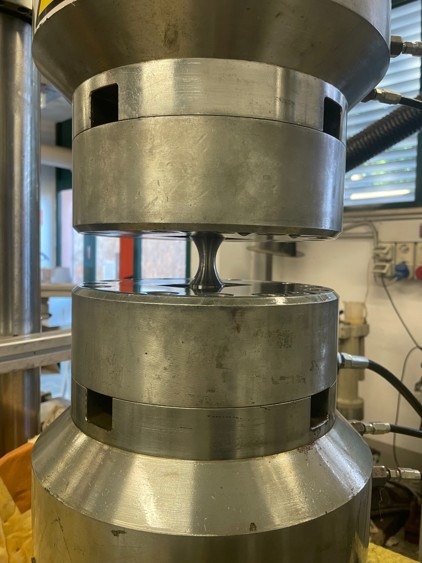
Participants are asked to submit blind fatigue-life predictions for 42CrMo4+QT steel specimens tested under high-cycle fatigue conditions. The blind target cases include plain and notched cylindrical specimens subjected to combined axial and torsional loading, including in-phase and 90° out-of-phase loading histories, with constant internal pressure.
The objective is to compare different fatigue-life prediction methods on the same well-characterised experimental basis and to assess their robustness under proportional and non-proportional multiaxial loading conditions.
Experimental database
Participants will receive a common experimental package including:
- specimen geometries and technical drawings;
- material information for 42CrMo4+QT steel;
- static tensile properties and fatigue calibration datasets (60 S-N curves and 1 Manson-Coffin curve);
- surface roughness measurements;
- hardness measurements;
- residual-stress information, when available;
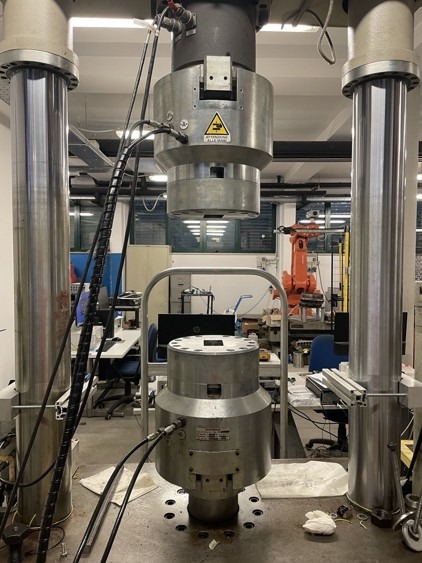
- test setup and test-sequence documentation;
- public blind load matrix;
- Excel submission template;
- Word and LaTeX method-description templates.
All competition information and datasets will be made available on Zenodo as downloadable zipped folders.
Key information
| Field | Information |
| Official launch | 28 June 2026, during IFC14, Madeira |
| Submission deadline | 31 October 2026 |
| Format | Blind fatigue-life prediction benchmark |
| Material | 42CrMo4+QT steel |
| Loading | Multiaxial loading (i.e. axial-torsional) with constant internal pressure |
| Specimens | Plain and notched cylindrical specimens |
| Submission files | Excel prediction template plus method-description document |
| Data access | Zenodo zipped package |
| Registration | here |
| Zenodo package | here |
Prizes and recognition
Research groups may participate in the competition; however, only one person per group can receive the prize.
Prizes will be awarded to the two best predictions:
- 1st place: funding for one-month Short-Term Scientific Mission (STSM) within FABER COST Action framework;
- 2nd place: free participation in the 2nd Annual FABER Conference 2027
Both first- and second-place contributors will also be invited to join as co-authors of the round-robin paper presenting the competition results, which will be published in a high-impact journal.
How to participate
- Register for the competition, so that you can be updated whenever some new information is delivered.
- Download the FABEST HCF Zenodo package.
- Access the paper submitted to Data in Brief journal to document the data package of item 2.
- Read the Start Here file and the Competition Rules including evaluation metrics.
- Study the experimental basis, specimen geometries, load matrix and test-protocol documents.
- Calibrate the fatigue model using the provided experimental data.
- Complete the Excel prediction template.
- Complete either the Word or LaTeX method-description template.
- Submit the required files before the deadline of October 31.
Flyer:
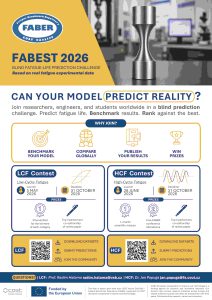
Clicking on the picture above will redirect to the high-resolution .pdf format of the flyer.
The design is made by Silvia Balloni. More of the author’s work can be found here.
Contacts
For questions about the HCF competition:
- Prof. Michaela Gkantou, [email protected],
- Dr. Jan Papuga, [email protected],
- Dr. Andrea Chiocca, [email protected]
Timeline
| July 27, 2026 | Official launch of the competition and publication of the main competition package |
| August 31, 2026 | Completion of manufacturing of all fatigue specimens (University of Pisa) |
| September 21, 2026 | Publication of residual stress measurements on surface and their depth profiles |
| October 31, 2026 | Submission deadline for fatigue-strength predictions |
| January 31, 2027 | Completion of the experimental fatigue campaign |
| February 28, 2027 | Announcement of the competition winners |
| Early May 2027 | FABER Conference – presentation of results; 2nd prize winner invited |
| July 13-15, 2027 | Official presentation of competition results at Fatigue 2027, Cambridge |
| September 30, 2027 | Deadline for completion of the STSM by the 1st prize winner |
| October 31, 2027 | Planned launch of FABEST Competition Vol. 2 |
Updates:
- July 27, 2026: The FABEST HCF Competition is now open
The FABEST High-Cycle Fatigue Competition is now open for registration. Researchers working in fatigue assessment, structural integrity, multiaxial fatigue and related fields are invited to participate.
The competition package, including the blind matrix, specimen geometries, manufacturing information, competition rules and submission templates, is available on Zenodo.
Additional material—including surface roughness and residual stress measurements—will be released as it becomes available. Registered participants will be notified of every update.
The submission deadline is 31 October 2026.
Researchers are encouraged to register early and start exploring both the competition package and the accompanying repository containing experimental evidence obtained on the same material batch.