Accurate fatigue life predictions are essential for enhancing the durability and safety of materials and components. WG4 focuses on assembling benchmarks for seven fatigue estimation categories, addressing critical knowledge and technology gaps in the field.
In this work group, WG 4.3, we focus our attention on multiaxial aspects of (high) cycle fatigue.
A review of recent scientific literature covering multiaxial fatigue models is being prepared. There are a surprizing number of publications available, and we will not be able to include them all.
These models will be categorized according to various criteria, and a small selection of them are to be analyzed in great detail and put to a thorough test based on a substantial amount of experimental data. For this purpose, a python-based code is being prepared. We intend to make this available to the public together with the review article, with the potential to add more models in a later phase.
No need to say that these analyses require us to put in substantial effort, and we can always use your help. If you think you have a multiaxial fatigue description and can program it in python, become a member of the FABER consortium and let us know: contact
Recorded Presentations
We also organize presentations about the topic, one of which has been recorded and is publicly available:
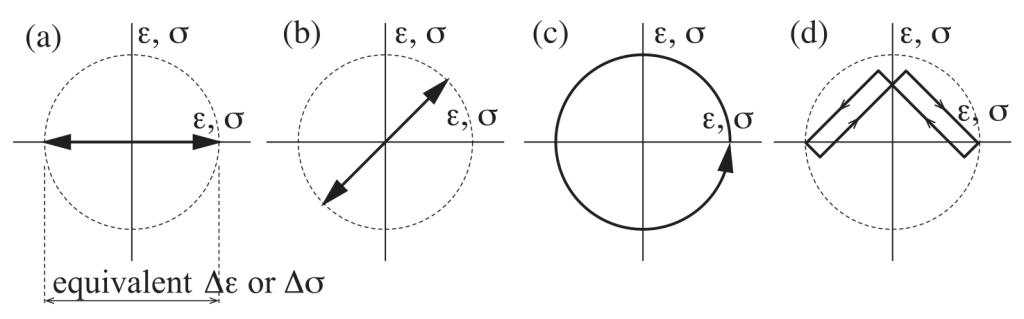
When is multiaxial fatigue non-proportional? The short animation may give you some intuitive insight.
When Theta_p, the angle between the maximum principal stress and the sigma-direction, is constant then the path is proportional. If not, it is non-proportional.